




The Rise of Predictive NetSuite Support: Fixing Problems Before They Happen
Break-fix support waits for something to go wrong. A growing number of teams are moving to a model that catches the problem first. Here is what that shift looks like, and how to make it.
Most NetSuite problems do not arrive with a warning. An integration quietly stops syncing, a saved search starts returning the wrong figure, or a script slows down just enough to time out on a busy day. The issue stays invisible until it surfaces somewhere expensive, like a month-end close that no longer reconciles, and by then the team is doing forensic work instead of finishing.
Most NetSuite teams know the pattern. For years, support has worked one way: something breaks, you raise a ticket, you wait. That model is starting to look its age. A different approach, often called predictive or proactive support, turns the sequence around. Instead of waiting for failures, it watches for the early signs and resolves them before they ever reach a user.
Key takeaways
- Break-fix support is reactive by design, so the business absorbs the damage before help arrives.
- Predictive support continuously monitors integrations, scripts, performance, and data to catch issues early.
- Testing customizations in a sandbox ahead of NetSuite's two yearly releases prevents most update-day surprises.
- The real return is fewer outages, a protected month-end close, and a support cost you can plan for.
- Moving from reactive to predictive is mostly about monitoring, a release cadence, clear KPIs, and the right partner.
The break-fix model, and what it really costs
Break-fix support is the model almost everyone started with. The system runs until something fails, a user notices, a ticket goes in, and the clock starts on a fix. It feels economical because you only pay for help when you need it. The catch is that the failure has already happened by the time anyone is working on it.
That gap is where the real cost lives, and very little of it shows up on the support invoice. A stalled integration delays a close. A broken saved search feeds a wrong number into a board report. A slow script times out during a busy order day. Each of these has a price in lost hours, lost trust, and decisions made on bad data, and none of it is captured by counting tickets.
Break-fix is not cheap support. It is expensive support with the bill deferred.
What predictive NetSuite support actually means
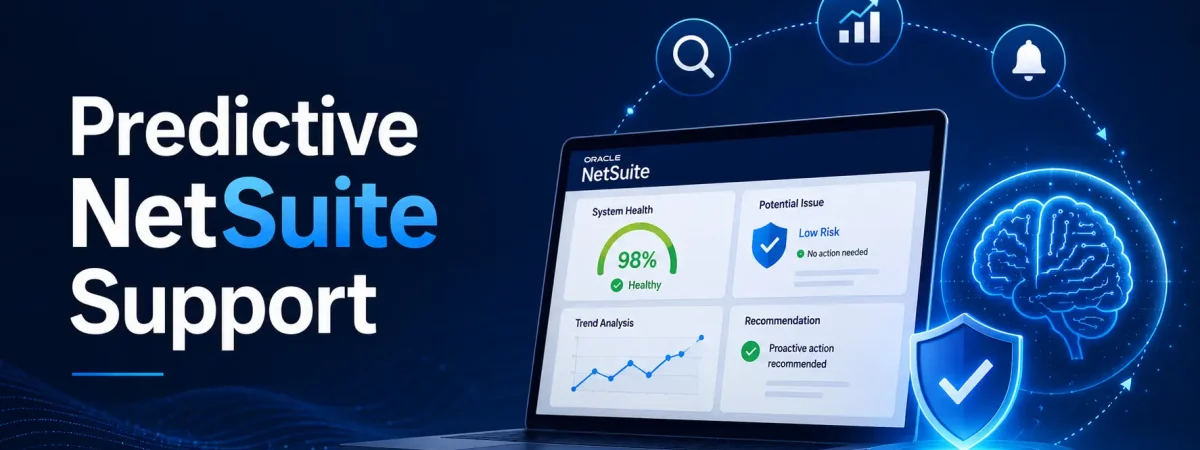
Predictive NetSuite support is a proactive model that continuously monitors your environment, surfaces anomalies and risks early, and resolves them before they disrupt users or operations. The difference from reactive support is not speed, it is posture. Rather than answering the question "what broke," it keeps asking "what is about to."
In practice that means the system itself, plus the people supporting it, are looking at signals the average user never sees: integration logs, script performance, governance limits, data quality, and the behaviour of upcoming platform changes. When one of those signals drifts, the work starts then, not after the next failed close.
How it works in practice
Predictive support is less a single tool than a set of habits and instrumentation working together. Four pieces do most of the work.
1. Continuous monitoring of integrations and scripts
Integrations and custom scripts are where NetSuite environments tend to fail quietly. Predictive support wires up automated alerts on error logs, failed scheduled scripts, and stalled connections, so a broken data flow raises a flag the moment it stops, instead of at month-end. Saved searches and native error logging do a surprising amount of this work once they are set up deliberately.
2. Release readiness for the twice-yearly updates
NetSuite ships two major releases a year, and every customization or integration you rely on meets that update whether you are ready or not. Predictive support tests in a sandbox ahead of each release, looking for deprecated features, SuiteScript that needs attention, and workflows that behave differently. The fixes happen before the release reaches your production account, not in a panic afterward.
3. Data integrity and anomaly detection
Bad data rarely announces itself. A duplicate record, a mis-mapped field, or a reconciliation that slowly drifts can sit unnoticed for weeks. Proactive monitoring watches for the patterns that signal trouble, and this is where analytics and, increasingly, AI earn their place: spotting the transaction or the trend that does not fit, and flagging it for a human to judge.
4. Performance and governance monitoring
Slow is the failure mode users complain about most and report least precisely. Watching script execution, search performance, and governance usage means you see a process getting heavier before it starts timing out. Tuning it then is a quiet maintenance task. Tuning it after it fails on a peak day is an incident.
The goal is simple: your users should never be the monitoring system.
Why predictive support is rising now
Proactive support is not a new idea, but a few things have made it both more necessary and more achievable. NetSuite environments have grown more complex, with more integrations, more customization, and more channels depending on them, which means more places to fail. At the same time, the cost of downtime has climbed, because more of the business now runs through the platform in real time.
The tooling has also caught up. Native analytics, performance monitoring, and well-built saved-search alerting make early signals visible without heroic effort. And AI has started to matter in a concrete way, not as a buzzword but as pattern detection: surfacing the anomaly in a sea of normal activity that a person would never have time to find. Put together, the early warning signs that used to be invisible are now within reach for any team that decides to look.
The business case
The argument for predictive support is not really about technology, it is about risk and predictability. The benefits tend to land in four places:
- Less downtime. Issues caught early rarely become outages, so the system stays available when the business needs it.
- A protected close. When integrations and data are monitored, month-end stops being a recurring gamble.
- Predictable cost. Planned, proactive work replaces unplanned firefighting, which is easier to budget and usually cheaper overall.
- Better adoption. A system that quietly works earns the trust of the people who use it, which protects the investment you made in it.
The clearest way to frame it for a finance audience: predictive support converts a series of unpredictable, high-impact incidents into a steady, lower line item. You are not spending more on support, you are spending it differently, and on prevention instead of recovery.
Moving from reactive to predictive
You do not need to rebuild your support model overnight. The shift is mostly a sequence of deliberate steps:
- Instrument the risky parts first. Put alerting on your integrations, scheduled scripts, and the saved searches that feed real decisions.
- Adopt a release cadence. Treat each NetSuite release as a scheduled event, with sandbox testing booked in before it goes live.
- Define health KPIs. Decide what "healthy" means in numbers: failed jobs, script performance, error rates, close timing.
- Schedule regular reviews. A recurring health review turns monitoring data into decisions, rather than dashboards no one reads.
- Choose a proactive partner. Whether internal or external, support should be measured on problems prevented, not just tickets closed.
What to look for in a support partner
If you are evaluating outside help, the language gives the model away. Reactive providers talk about response times and ticket volumes. Proactive ones talk about monitoring, release management, and the issues you never had to hear about. Look for named, certified people who know your account, transparency about what is being watched, and a service built around prevention rather than recovery.
This is the work we focus on at Velaura. We have implemented, rescued, and supported NetSuite environments since 2013, and the support we are proudest of is the kind our clients barely notice, because the problems were handled before they surfaced. If your current support only shows up after something breaks, it may be worth a second look.
Frequently asked questions
What is predictive NetSuite support?+
How is predictive support different from break-fix support?+
Can predictive support prevent issues during NetSuite's twice-yearly releases?+
What does predictive NetSuite support typically include?+
Is predictive NetSuite support worth it for smaller companies?+
Velaura has implemented, optimized, and supported NetSuite environments since 2013, across manufacturing, distribution, healthcare, and consumer brands. We write about NetSuite strategy, support, and optimization for the finance and operations leaders who run them.
Is your NetSuite support reactive or predictive?
Talk to Velaura about a health check that finds the issues hiding in your environment before they find you.
Get a Free Consultation