





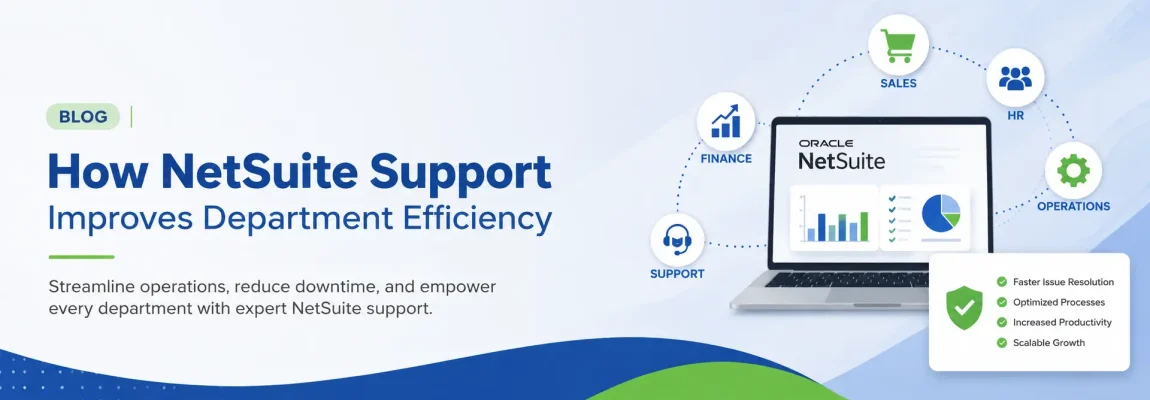
How NetSuite Support Eliminates Operational Bottlenecks Across Departments
The worst bottlenecks rarely sit inside one team. They live in the gaps between them. Here is how the right NetSuite support clears those gaps, department by department.
Every growing company hits the same wall. The tools that worked at a smaller scale start to creak, approvals pile up, and reports take longer to pull than to read. Work stalls while it waits on another team. The platform is rarely the whole problem. More often it is how the platform has been set up, and how it is supported as the business changes.
NetSuite is built to run an entire business on one system, which is exactly why bottlenecks show up so clearly when something is off. The encouraging part is that most of them are fixable, and not through a costly re-implementation. Proactive NetSuite support, the kind focused on optimization rather than only break-fix, is usually the fastest way to clear them.
Key takeaways
- Most operational bottlenecks live at the handoffs between departments, not inside them.
- The usual culprits are manual workarounds, slow approvals, disconnected data, and reports nobody can pull quickly.
- NetSuite support clears them with automation, workflows, dashboards, integrations, and process redesign.
- The biggest wins tend to be in the financial close, order-to-cash, and inventory or fulfillment.
- A structured review or health check is the practical first step to finding where time is lost.
What an operational bottleneck looks like in NetSuite
An operational bottleneck is any point where work piles up faster than it can move through, slowing everything downstream. In a NetSuite environment it usually shows up in familiar ways: a process that still runs on a spreadsheet, an approval that sits in someone's inbox for days, data that has to be rekeyed from one screen to another, or a report that takes half a morning to assemble.
Individually these look like minor annoyances. Together they set the pace of the whole business, and that pace is almost always slower than it needs to be.
Why bottlenecks cluster at department handoffs
If you watch where work actually slows down, it is rarely in the middle of a task. It is at the moment one team passes something to the next. Sales closes a deal and waits on finance to set up the customer. Operations needs a number that lives in someone else's report. Procurement holds a project up because an approval never moved.
This is where running on one platform should help, and where good configuration makes the difference. NetSuite can carry a record cleanly from one department to the next, but only if the workflow, permissions, and data are set up to let it. When they are not, the seams between teams fill up with spreadsheets and email, and that is where the time goes.
The slowest part of most processes is not the work. It is the wait between the people doing it.
Finance and accounting
Finance feels every other department's bottleneck eventually, because it all lands in the close. The common drags are manual reconciliations, approvals chased by email, and reports rebuilt by hand each month. NetSuite support clears these by automating reconciliations, routing approvals through defined workflows, and replacing manual reporting with live dashboards. The result is a close measured in days instead of weeks, and numbers leadership can trust without a caveat.
Sales and order-to-cash
In order-to-cash, the bottleneck is usually the handoffs: quote to order, order to fulfillment, fulfillment to invoice. Each manual step adds delay and a chance for error. Support tightens this by automating order flow, standardizing pricing and approvals, and connecting sales records straight through to billing, so a closed deal turns into cash with fewer hands touching it.
Operations, inventory, and fulfillment
For operations, bottlenecks show up as stockouts, overstock, and orders that ship late. They usually trace back to inventory data that is updated by hand or scattered across systems. Support addresses this with real-time inventory, sensible reorder points and demand planning, and tighter warehouse and fulfillment workflows, so the right stock is in the right place without someone watching it constantly.
Procurement and approvals
Procurement bottlenecks are quieter but expensive. Purchase orders stall waiting for sign-off, and without clear visibility, spend slips through uncontrolled. Support fixes this with structured approval routing, committed-cost visibility against budgets, and vendor records that keep sourcing accountable, so buying keeps moving without losing control.
How support actually clears the blockage
Clearing a bottleneck is less about adding features and more about removing friction. Proactive NetSuite support tends to work in a consistent order:
- Find it. A structured process review or health check shows where work actually slows, rather than where people assume it does.
- Automate the repetitive. Workflows, approval routing, and scheduled processes take the manual steps out of the path.
- Surface the data. Saved searches and dashboards put the right number in front of the right person, so no one waits on a report.
- Connect the systems. Integrations remove the rekeying between NetSuite and the other tools the business relies on.
- Support adoption. A cleared bottleneck only stays cleared if people use the new process, which is why training and follow-through matter.
A single stalled approval workflow can hold up an entire department. Re-routing it and adding a dashboard so managers can see what is waiting is a small change with an outsized effect, and it is exactly the kind of fix proactive support is built to find and make.
Where to start
You do not need to fix everything at once. Map the handoffs where work consistently slows, put a rough number on what each one costs in time, and start with the one that hurts most. Favor configuration over customization wherever you can, since it is faster to deliver and easier to maintain. Most importantly, treat this as ongoing work rather than a one-time cleanup, because a growing business keeps generating new bottlenecks as it changes.
That is the work we focus on at Velaura. We help teams find where their NetSuite environment is slowing them down, then clear it, department by department, so the platform speeds the business up instead of holding it back.
Frequently asked questions
What causes operational bottlenecks in NetSuite?+
Can NetSuite support fix bottlenecks without a re-implementation?+
Which departments see the biggest improvement?+
How does NetSuite support find bottlenecks in the first place?+
How quickly can bottlenecks be cleared?+
Velaura has implemented, optimized, and supported NetSuite environments since 2013, across manufacturing, distribution, healthcare, and consumer brands. We write about NetSuite strategy, support, and optimization for the finance and operations leaders who run them.
Where are your NetSuite bottlenecks?
Talk to Velaura about a health check that maps where work is stalling across your departments, and how to clear it.
Get a Free Consultation